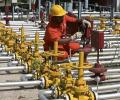
The oil ministry has stopped making fresh allocation of natural gas from domestic fields to the city gas sector, threatening the viability of Rs 2 lakh crore investment planned in the sector besides leading to a hike in CNG and piped cooking gas prices to record levels, sources said. Despite a decision of the Union Cabinet to give 100 per cent gas supply under 'no cut' priority to the city gas distribution (CGD) sector, current supplies have been maintained at March 2021 demand level. Besides, the process of allocating gas on a six-monthly average drawl also is punishing the CGD entities driving growth.

If Modi wants to leave a real legacy, breaking India's strategic triangulation would be the real gift, notes Shekhar Gupta.

The government of India had budgeted to bring down fiscal deficit to 4.8 per cent of GDP in the current financial year, from 4.9 per cent in 2012-13.
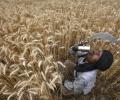
Nirmala Sitharaman's maiden Budget has not disappointed but vision and details, particularly for the revival of agriculture, are missing.

A cut in government spending would come at the cost of growth.
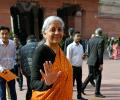
The deficit stood over Rs 8 trillion in the first seven months of the current financial year. Non-tax revenues, comprising transfers from the RBI and dividends of the public sector units, shored up the Centre's revenues.

'That is the one headline the world is reading about India this week, and it is a potentially damaging story...' 'I don't think a panic mentality has set in, but this story is one that investors and market watchers are absolutely seized with.'
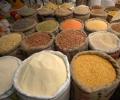
Now the PMO needs to take the food sector reforms forward.

Making sense of the international crude market is incredibly hard.
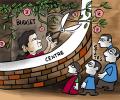
'It is just an excuse to say that the Centre has run out of money.' 'Pruning these schemes would mean hard time for the people of India.'
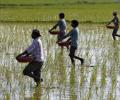
Telangana's Rythu Bandhu policy is an embryonic UBI, or rather embryonic QUBI (a quasi-universal basic income, pronounced Kyoo-Bee). And it could potentially also be the future of agricultural policy in India, says Arvind Subramanian.

'Let us hope that this Budget delivers.' 'It needs 10 per cent plus real GDP growth in 2021-22, the rebound year,' notes Omkar Goswami.

Finance Minister Nirmala Sitharaman on Thursday announced a Rs 11.11 lakh crore spending on infrastructure and vowed to continue reforms as she resisted resorting to populist measures in Modi government's last Budget before general elections, instead choosing to stay on the path of cutting deficit while bolstering measures for focus groups.
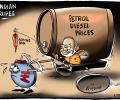
Oil sank to the lowest level in a month after shedding all of its gains from the US-Iran clash as traders waited to see whether any further hostilities will disrupt exports from the East Asia.

The government has budgeted for total expenditure of Rs 34.83 lakh crore or 6.8 per cent of GDP. While the net tax revenue rose from Rs 5,75,697 crore in October 2020 to Rs 10,53,135 crore till October 2021, a growth of 82.93 per cent annualized, total expenditure rose only by 9.95 per cent, led by infra spending to Rs 18,26,725 crore from Rs 16,61,454 crore during the same period, the RBI said in the financial stability report.
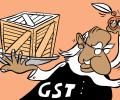
It is now becoming increasingly clear that rising imports have played a significant role in sustaining the buoyancy in revenues from GST, notes A K Bhattacharya.

Foreign brokerage Goldman Sachs on Monday said it expects new Finance Minister Arun Jaitley to peg the fiscal deficit target for FY15 at 4.3 per cent, up from the 4.1 per cent stated by his predecessor P Chidambaram.

By any economic theory or doctrine, this is no Budget that supports economic recovery, whether through supporting aggregate demand, or through expansionary stimulus, declares Rathin Roy.

India will take a decision on freeing the pricing of heavily subsidised gas by July, Petroleum Minister Ram Naik told a gas industry seminar in Mumbai on Wednesday.\n\n\n\n

However, the growth during the next financial year would be higher at 8.1 per cent in case of a second wave of the coronavirus and bit slower at 7.9 per cent if the virus recedes and remains under control.

If the Budget makes no big announcements on new schemes, projects, or tax giveaways, the government would face a major political dilemma as it may have to reluctantly consider shunning the practice of unveiling pre-election sops to woo voters, notes A K Bhattacharya.

The Survey estimated that a UBI that reduces poverty to 0.5 per cent would cost 4-5 per cent of GDP, assuming that those in the top 25 per cent income bracket are not part of the loop.
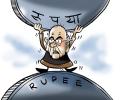
While the finance minister had a great opportunity to come out with flying colours while presenting this last Budget of his government, he didn't, says Omkar Goswami.

The government's largesse was widely expected after the ruling Bharatiya Janata Party lost power in the recent assembly polls in three Hindi heartland states, where rural distress was cited to be one of the reasons for the defeat of the saffron party.
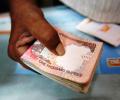
This is the Centre's highest-ever budgeted capital outlay.

Pahal looks to cut down diversion and eliminate duplicate.

Lower crude prices mean less government outlay for India,
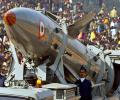
Free provision of food, cash transfers, and jobs in villages see enhanced flow of funds despite a precipitous fall in revenue. Till May, defence spend was nearly 30 per cent less than the previous year.

The Nifty and Sensex traded close to their respective all-time highs.
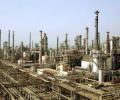
A nearly two-fold hike in natural gas prices will incentivise investment in the hydrocarbon sector and help reduce the energy import bill, India Inc said.
Expectations from this Budget are sky-high.

'He is exposing the failings of the BJP, which is rankling the party.'
Alas, the 'basic income' schemes that have hit the headlines in the recent past are a far cry from the genuine article in terms of coverage and fiscal implications, says Vijay Joshi.
The state's revenue receipts might not afford various freebies announced by the parties, unless revenue deficit and hence fiscal deficit is widened.

Do the actual numbers bear out the claims made by the government or do they suggest something else? asks A K Bhattacharya.
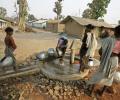
In May, Satpal Singh, who runs a dairy business with three buffaloes in Jewar, near Noida, was worried about the steep spike in input costs. Singh said dry fodder rates, which cost Rs 1,500-2000 per tractor trolley last year, were quoting at Rs 4,500-5,000. The price of other cattle feed ingredients (that include mustard meal and similar mixes) had also gone up from Rs 2,000 per quintal to Rs 3,100-3,200 per quintal.

Prime Minister Narendra Modi on Saturday announced the adoption of the New Delhi Leaders Declaration, a significant victory for India's G20 presidency that came amid increasing tensions and divergent views over the Ukraine conflict.
India must streamline reforms, only then it will see success.

'UBI is a tricky subject.' 'Our worry is the government could get rid of UPA's social welfare schemes targeted at the poor.'
It is time for the three finance ministers of the 1990s to reveal the real hero, says T C A Srinavasa-Raghavan.
